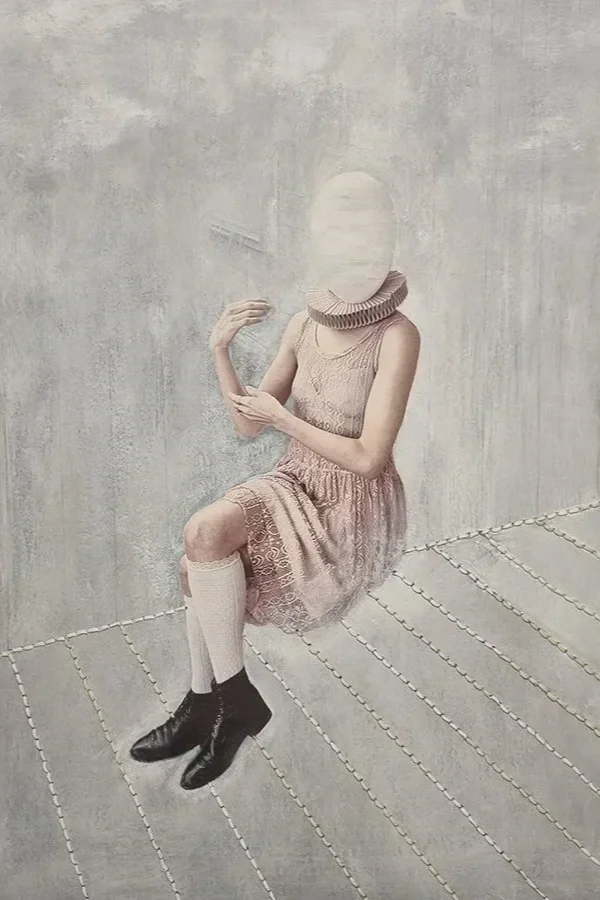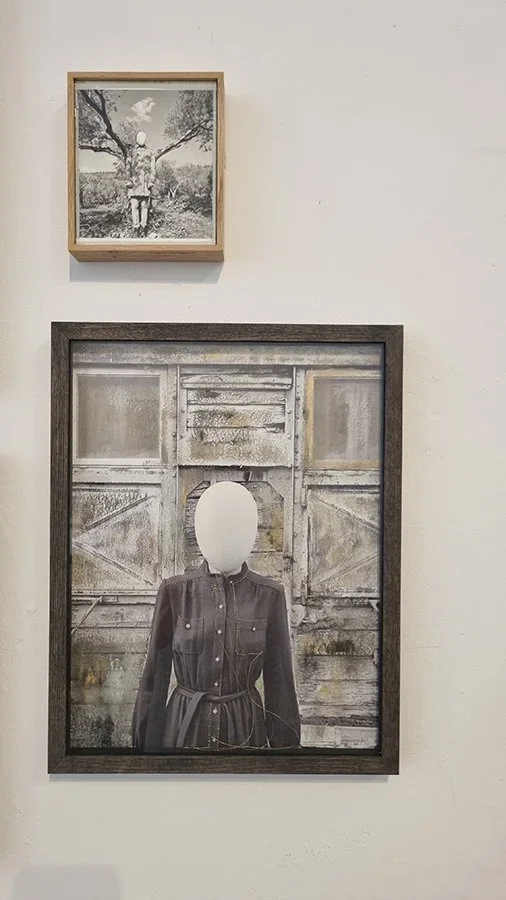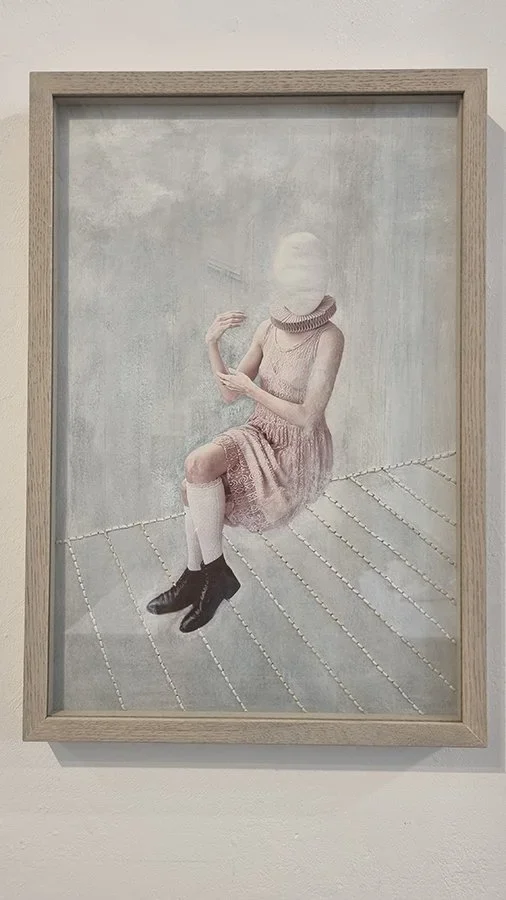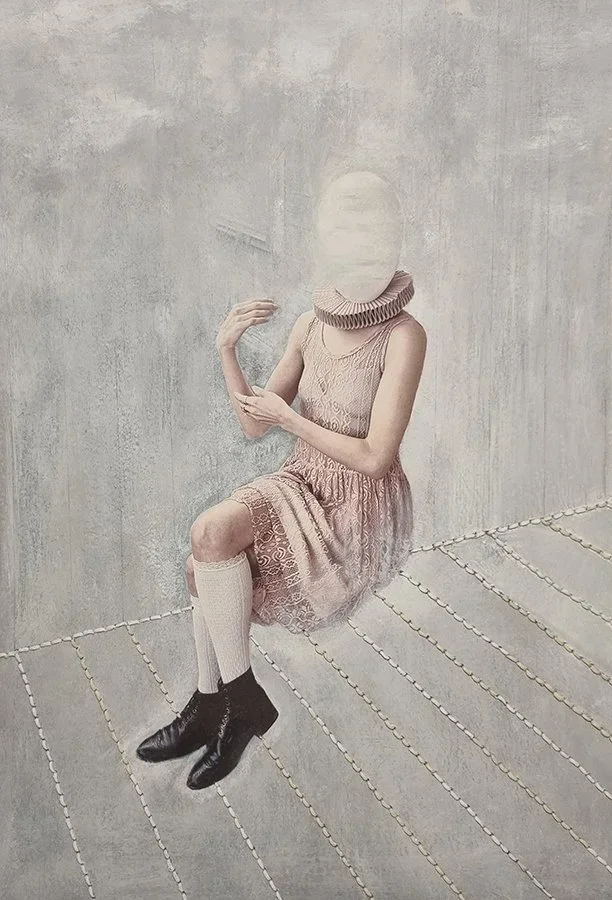
Land Escape, 2024
Embroidery, photography, oil painting
London, 2020
Analog Photography
Solo Exhibition
By5 Gallery, September 2025
Curator Nir Harmat
To enter Liminis is to cross a threshold: a space where matter is no longer merely physical, but a stage where memory, image, and consciousness converge. Li Chen weaves a world where reality and imagination entwine, where material becomes a living presence, carrying myth, emotion, and the traces of personal history. Echoing Pygmalion, her figures stir to life, prompting reflections on identity, the body, and the mysterious possibility that an object can open a gateway to inner passage.
The exhibition presents four life-sized gatekeepers: the Moon Woman, the Welder, the Tree-Woman, and the Sewn Robot. Each embodies a boundary—between light and shadow, craft and matter, human and nature, organic and artificial. They are mythic actors, dreamlike sentinels, refusing immediate passage; they ask the viewer to pause, to witness, to recognize the act of crossing.
Gatekeepers appear across cultures: Cerberus at the gates of the underworld, angels and monsters challenging heroes, Persephone straddling life and death. From a Jungian perspective, they symbolize fear and doubt that arrest the journey until readiness arrives. Chen embraces this figure not as a barrier but as an invitation: meeting the gatekeepers is a moment of transformation.
Around them, symbols unfold: shoes tracing contact with the earth, marking the passage from reality to image; a pearl cradled in a shell, hinting at inner listening and growth born of struggle; a keepsake box of archival fragments—stones, shells, shards of sculpture—remnants of a journey; and butterflies floating in the space, reminding us of metamorphosis’s delicacy against matter’s weight.
The figures and objects in Liminis question the essence of beauty: does it dwell in formal perfection, glossy materiality, or rather in flaw, scar, incompleteness? Here the aesthetic collides with the ethical—the seductive image draws desire, yet demands reflection, responsibility, acknowledgment of pain and fracture. Chen places the viewer in a double stance: to luxuriate in the image while contemplating the moral and emotional cost of its creation and perception.
Between mythology and psychology, living matter and elusive image, ancient and contemporary, intimate and epic, Liminis conjures a space where the threshold exists not only at the gate, but within us.
Tefillin
Israeli Glass biennale 2015
״Chen's expressive artistic interventions in two undeniable emblems of Jewish ancestry- a pair of corroding iron handcuffs attached to the leather straps of tefillin, and a leather whip with eight twined a knotted strands attached to the tzitzit(instead of the tzitzit's eight tassels) - convey personal insights about the controversial educational methods and the authoritative way in which religious world views are disseminated״
Henrietta Eliezer Brunner | Curator of Glass at The Eretz Israel Museum | Tel Aviv.
Photo by : Leonid Padrul, © Eretz Israel Museum, Tel Aviv
Mixed- media : kiln casting, cold worked glass, leather, iron
Size: 8X9X10cm
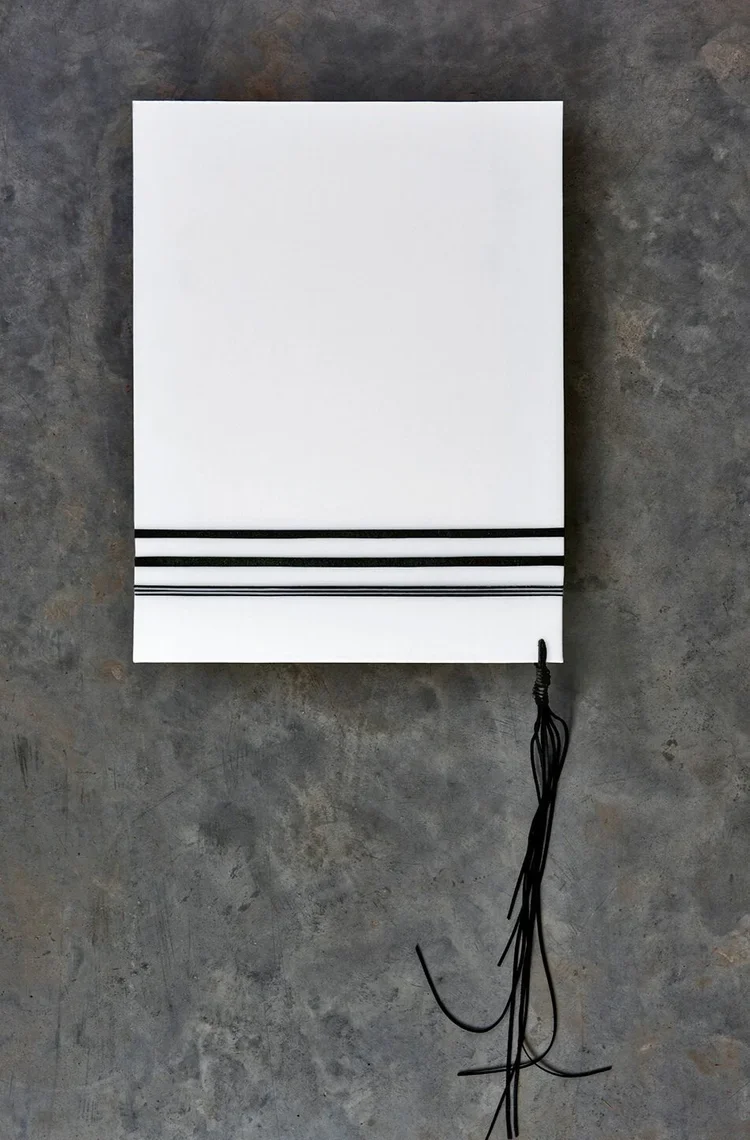
Tzitzit
Mixed-Media Fused Glass, Lether
Size : 60X45 cm
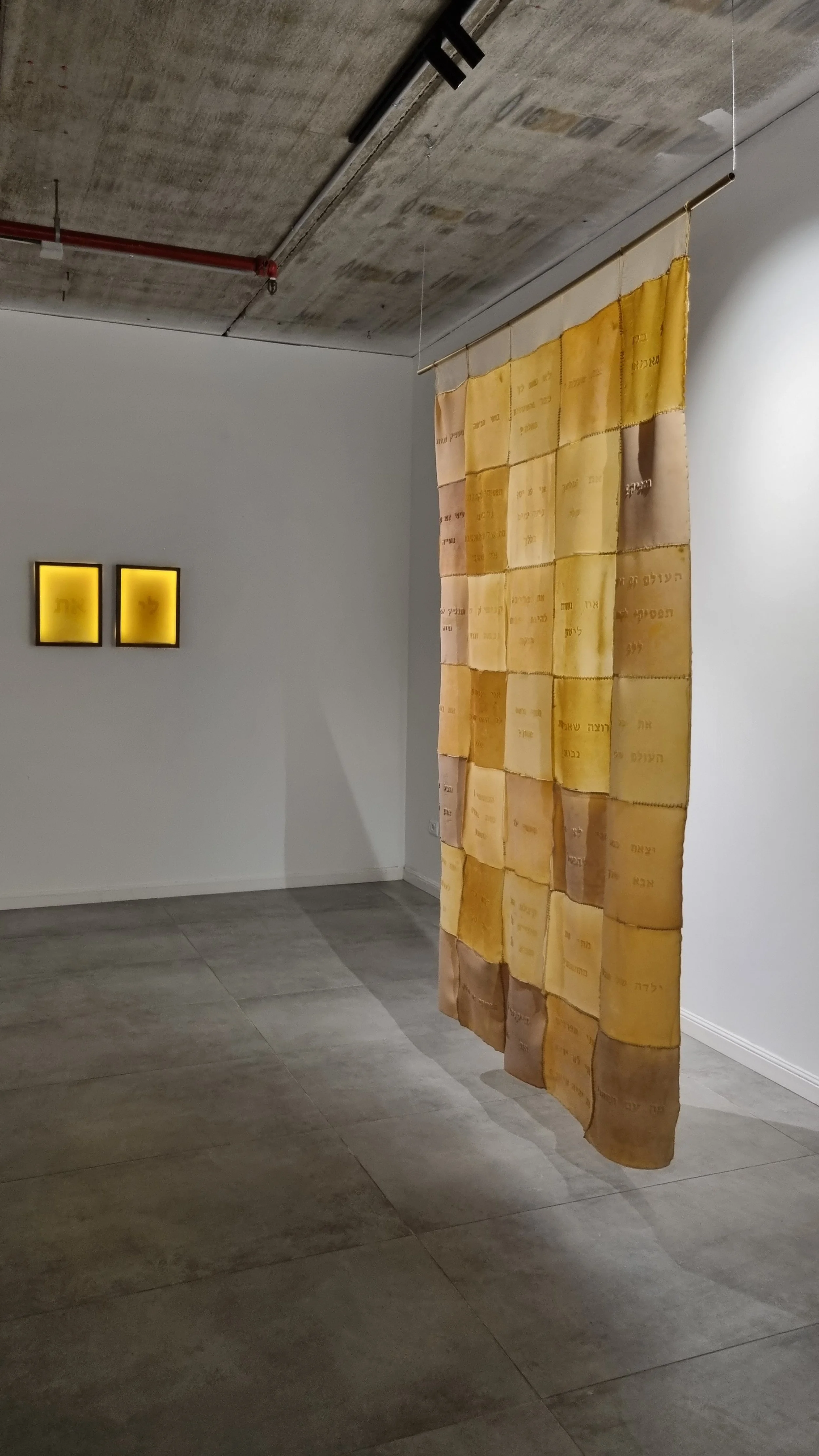
“Li-At” 2024,
Mixed-media latex Installation.
Li Chen’s father is a central, meaningful figure in her life. He is a present, caring and attentive father. Her childhood environment was the sign factory he managed. There, he demonstrated and explained with endless patience about the work, the materials, the neon signs, the sheet metal and the plexiglass (in the 1990s he produced the guitar for the. Hardrock Café at Dizengoff Center). ֿThe passion for working with materials is a multigenerational legacy. Her grandfather taught her father welding and how to work with sculptural materials, molds and casts. During her studies in the Department of Ceramics and Glass Design at Bezalel, her father helped her create letters, boxes, and frames, as well as helped with the installation of exhibitions. Over the years, Chen collected sentences he would repeat and notes he would leave for her before he went to work: “Stop buying tights, but don’t save on anything connected to your art.” “I fixed your car.” “I bought you fish and a few things.” “I can’t sleep because of you.” “Enough”. “Come home.” “You got your grandfather’s hands.” “You are my whole world.” “The world sucks, stop taking things personally.” “My whole life he has been beside me, making sure I have everything I need. He asks, shows interest, helps and blurts out caring sentences which are sometimes even annoying but usually funny,” says Chen. His words are so much a part of her it is as if they are tattooed on her skin. The flexible character, texture, and colour of the latex material in her works are reminiscent of human skin and represent the essence of their close relationship. The words are imprinted on the material as a reminder that references the sign factory. Positioning the work in the form of a blanket and a floor lamp are reminiscent of a warm,well-lit home. Her father named her “Li-at” after his own mother Leah. At the age of 20, she shortened her name to “Li”, as a symbolic act of embarking on her own independent path.
The exhibition Our Father is a tribute to Ruty Chinsky-Amitay, who was taken from this world tragically in January 2024, when she was at the pinnacle of her research at the Cité art residency in Paris. Ruty worked on this tender and delicate exhibition, which deals with relationships between fathers and daughters, throughout the last year of her life. After her death, Ruty’s life partner Ofer entrusted me with the list of artists and artworks Ruty had selected some time before, as well as her notes, which included references to articles and psychoanalytical sources which discuss the relationships between daughters and fathers and the appearance of these familial relationships in mythology. Ruty’s curatorial craft was cut short horrifically. In the notes provided to me, Ruty jotted down a single line containing several guiding questions that hint at her curatorial intentions: “To what extent did the relationships between daughters and fathers influence and dictate their art? In what way? What was overt and what was covert? What was the definitive moment? Sometimes these are things that become clear at a later stage.” What were Ruty’s thoughts and where did she plan to point the thematic spotlight? I will never know for sure. My conversations with the artists revealed a variety of father-daughter relationships. What they all had in common were similar characteristics of paternal presence/absence in their lives, as well as their context within worldwide societal and cultural conceptions.
Thus, I embarked on a journey of study led by the question: What is fatherhood?
"Our Father" Group Exhibition
Curators: The late Ruty Chinsky-Amitay and Rotem Ritov
Zuzu Gallery - www.zuzugallery.com
Latex, wax wires.
Size: 210hX160 cm
Light-box, Latex, glass, wood.
Size: 60hX40wX5d cm (each)
21-26 May 2025
Polymer, oil painting, textile, wood.
Size: 50hX40wX15d cm
Polymer, oil painting, textile, wood.
Size: 50hX40wX15d cm
Analog photography Black&White, T-max 400 kodak, 35 mm
At the beginning of my journey, coinciding with the onset of the COVID-19 pandemic, I embarked on a two-year exploration across Europe.
My first destination was London, where familiar tourist spots were unexpectedly devoid of people.
While exploring its eerily deserted streets, I stumbled upon a children's mask featuring the comic book hero 'Iron Man,' crafted from plastic and discarded beneath a rubbish bin.
This superhero mask, now reduced to a mere plastic remnant, seemed 'powerless' and stripped of its former significance.
I began capturing photographs of myself wearing the mask in various settings, feeling compelled to rejuvenate its essence. The mask transformed into a metaphorical filter, a symbolic barrier that separated me from reality.
London, Belgium, Netherlands, Portugal
Israeli Glass biennale 2015
"Chen's minimalist installation addresses personal narratives related to issues of femininity and gender roles. Paraphernalia, from ordinary daily beauty-care routine,and household chores are translated into meticulously crafted glass objects and placed within their natural habitat. yet, this habitat is transformed into a cold, lifeless, and alienated setting of surgical sterility"
Henrietta Eliezer Brunner | Curator of Glass at The Eretz Israel Museum | Tel Aviv.
Photos By Leonid Padrul, © Eretz Israel Museum, Tel Aviv
Glass Wires, Kiln casting, Mix media
5hX16wX5d cm
Glass Wires, Kiln casting, Mix media
Size: 6.5hX19wX6.5d cm
Glass Wires, Kiln casting, Mix media
12hX5wX5d cm
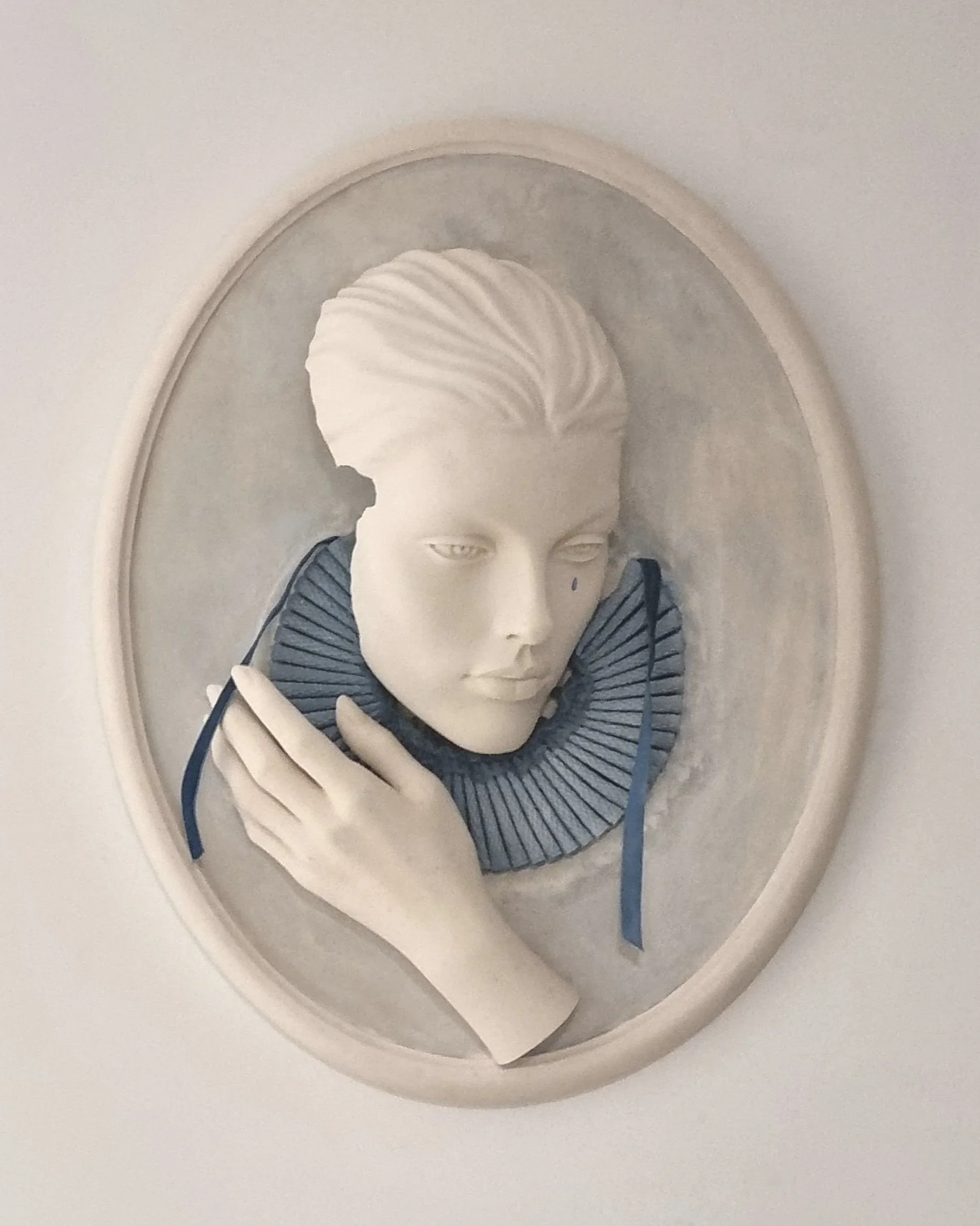
Self-portrait
Plaster, fabric ruffle collar, oil paint
25X25 cm